Cryogenic Flow Simulation
Three instrumented process pages share one Rust clock: liquid nitrogen, liquid argon and pure liquid methane. Switch pages while independent inventories keep moving, then trace leaks, boiling pools, frost and flare flameout from process state to the field view.
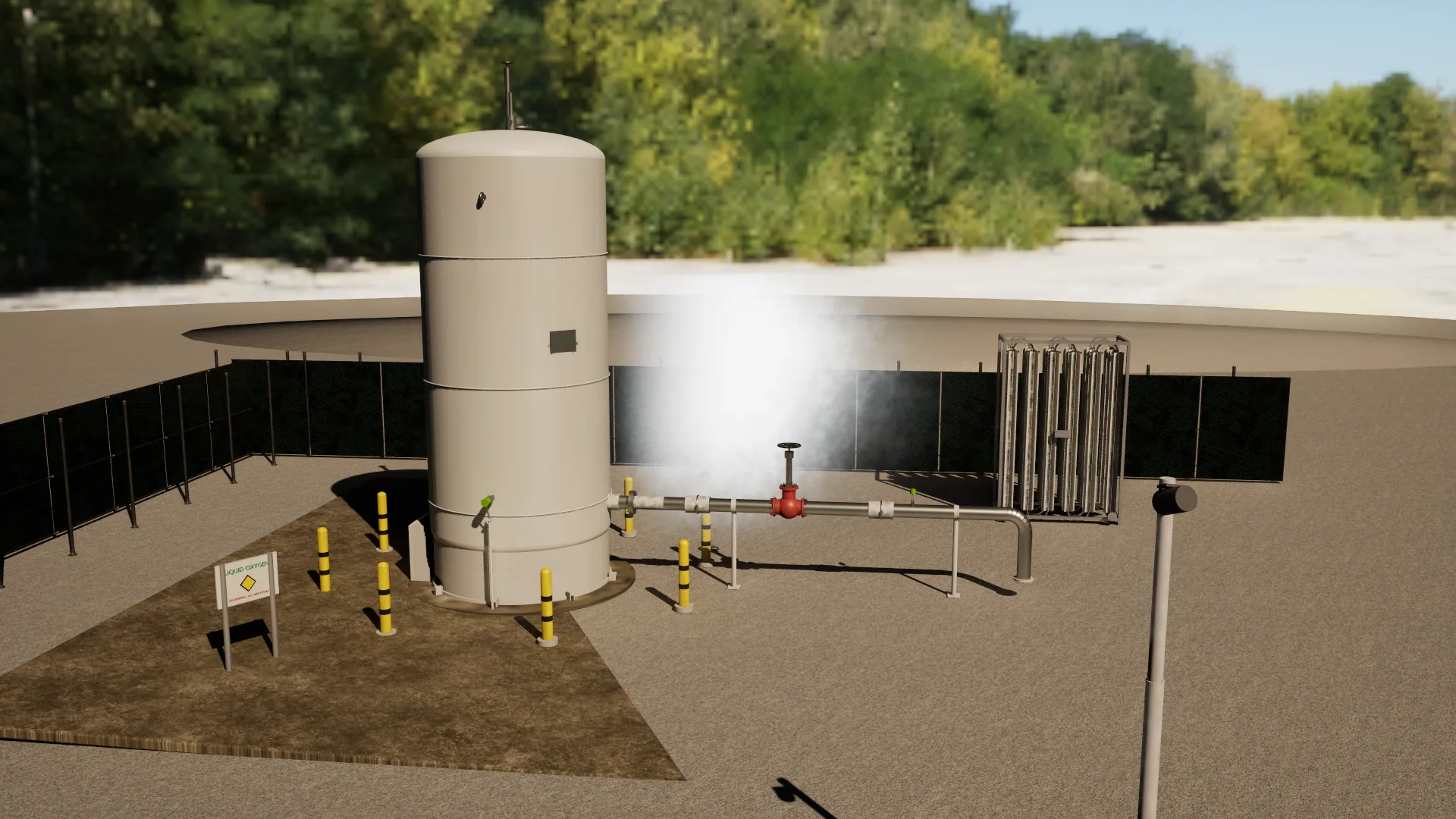
The new circuits run together while the operator changes pages. A nitrogen leak feeds a boiling pool; isolation closes the valve while residual liquid keeps evaporating. Methane pilot loss extinguishes the flare and raises an alarm. Live P&ID footage and an explicitly labeled native replay show those behaviors alongside the project's retained scale and camera evidence.
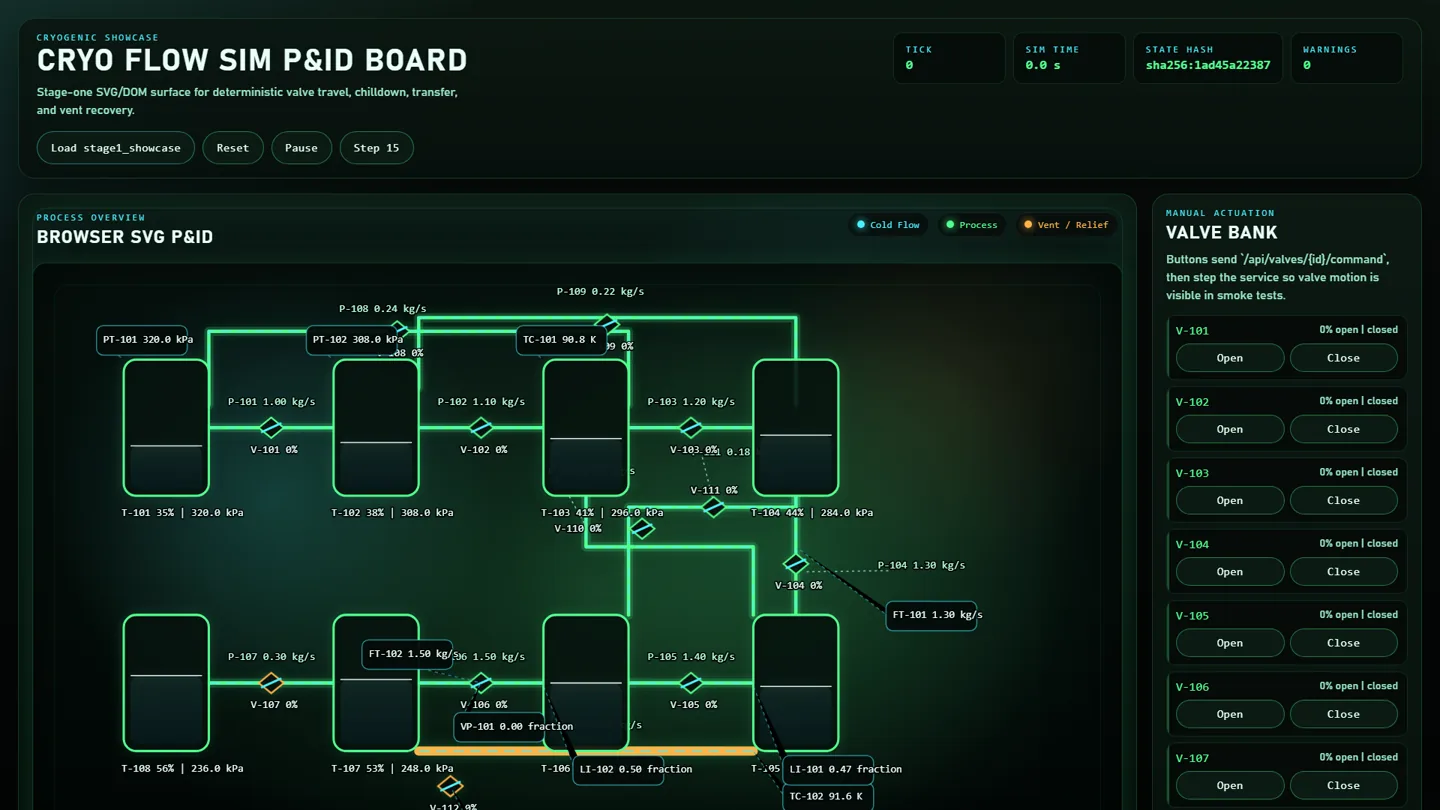
- Role
- Controls-domain translation informed by Siemens and Rockwell PLC experience, Rust workspace architecture, simulation implementation, capture pipeline, and artifact validation.
- System boundary
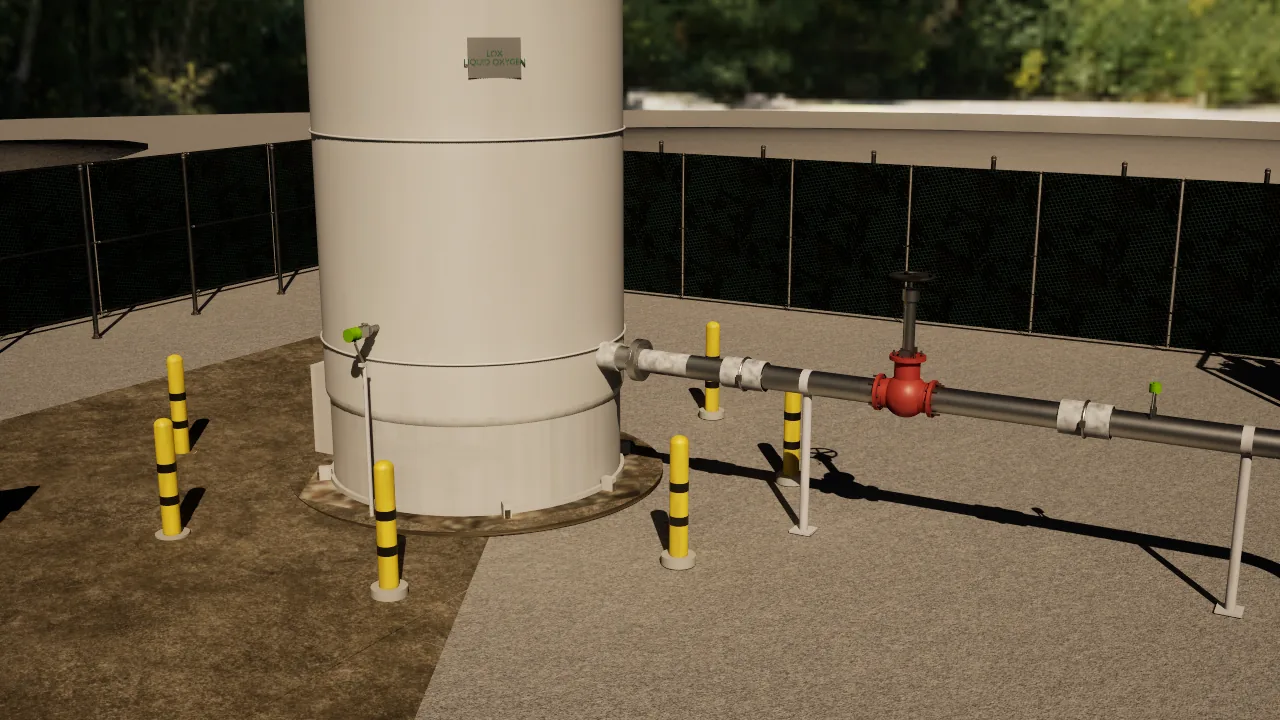
- The new process plant keeps three independent circuits inside the existing Rust simulation actor. Each vessel stores mass, internal energy and volume; a bounded pure-fluid saturation table determines its pressure, temperature and phase inventory. Valve travel, enthalpy transfer, heat ingress, vapor discharge and spill evaporation change that state. A pushed snapshot feeds the browser SVG/HTML/CSS P&IDs and qualitative canvas field view; page selection changes only the view. Blender-authored equipment and a separate Unreal scene provide a native visual presentation of recorded state. The earlier LOX topology, large generated fleet, fault library, controller and Unreal camera retain their own evidence boundaries.
- Primary constraint
- All behavior must be deterministic from a fixed seed so artifacts are reproducible and auditable.
- Strongest evidence
- Three concurrent process circuits extend the project; the figures below retain the scope of the earlier measured scale, replay and camera runs.
The situation
Control sequences are difficult to rehearse when the real facility is unavailable, incomplete, or too costly to place into every fault and boundary condition. The simulator needed reproducible state transitions across valves, tanks, pipes, and instrumentation without depending on live hardware.
A simulation that hides its assumptions can create false confidence at the exact conditions where engineering errors are most costly: low temperatures, pressure differentials, actuator timing, alarms, and recovery sequences.
Constraints
- All behavior must be deterministic from a fixed seed so artifacts are reproducible and auditable.
- No live hardware dependency; the simulation must run entirely from a Rust service with a browser-rendered UI.
- The capture pipeline must verify its own output with measurable thresholds, not just visual inspection.
- The current demonstration is not plant-calibrated, connected to PLC or DCS control logic, safety-authoritative, or an operational digital twin.
- Every increment is graded against an exit criterion fixed before the work starts; a milestone that misses a clause is recorded as not verified, never softened to pass.
My responsibility
Controls-domain translation informed by Siemens and Rockwell PLC experience, Rust workspace architecture, simulation implementation, capture pipeline, and artifact validation.
The system
The new process plant keeps three independent circuits inside the existing Rust simulation actor. Each vessel stores mass, internal energy and volume; a bounded pure-fluid saturation table determines its pressure, temperature and phase inventory. Valve travel, enthalpy transfer, heat ingress, vapor discharge and spill evaporation change that state. A pushed snapshot feeds the browser SVG/HTML/CSS P&IDs and qualitative canvas field view; page selection changes only the view. Blender-authored equipment and a separate Unreal scene provide a native visual presentation of recorded state. The earlier LOX topology, large generated fleet, fault library, controller and Unreal camera retain their own evidence boundaries.
Architecture descriptionOne Rust simulation clock advances nitrogen, argon and pure methane circuits; snapshots drive instrumented browser pages and recorded Blender and Unreal field effects.
Critical decisions
01
One clock, independent circuits
- Choice
- Keep all three process circuits in the Rust runtime; selecting a page changes only the visible instruments.
- Alternatives considered
- Run a separate animation or reset the model whenever a page opens.
- Tradeoff
- A shared tick makes cross-page behavior reproducible. Separate fluid inventories avoid mixing incompatible commodities, and the bounded new model leaves the historical oxygen and scale contracts intact.
02
Repeatable captures with measured checks
- Choice
- Drive the Stage 1 scenario from a fixed seed and scenario name, then validate OCR, motion, flow, tank, pipe, telemetry, and clamp thresholds after capture.
- Alternatives considered
- Rely on visual inspection alone.
- Tradeoff
- Thresholds are more trustworthy than inspection alone but require calibration against known-good runs. The September 2026 program generalized this: every milestone's exit criterion, budgets and negative controls were written before building and graded clause by clause with three verdict states (pass, fail, unmeasurable); several milestones were graded not verified on a first pass and re-graded only after the gap was measured and fixed.
03
Sell a bounded outcome before a platform
- Choice
- Start with a facility-specific control-sequence rehearsal engagement built from approved customer engineering information and acceptance scenarios.
- Alternatives considered
- Build a general simulation platform or multi-tenant SaaS before proving paid customer demand.
- Tradeoff
- Manual customer translation limits early software scale, but it tests the buyer, inputs, fidelity, acceptance criteria, and delivery economics before making a larger product commitment.
Proof
Process behavior and retained scale proofThree concurrent process circuits extend the project; the figures below retain the scope of the earlier measured scale, replay and camera runs.
- Evidence boundary
- The new process pages are a separate bounded implementation with source-linked properties, mass and energy accounting, targeted fault controls and real-service browser checks. They do not inherit the large-fleet performance result. Generated-scale evidence combines a deterministic offline capture from a fixed seed with a separately measured live real-time run; source commits and measured validation thresholds are recorded. The September 2026 program figures come from its exit-evidence records on a single Windows workstation and one Linux second device; each is a bounded current project claim, not a customer or facility result. In the retained scale capture, coordinated valve waves changed 24.3% of label-excluded fleet pixels versus a legacy 1.0% whole-percent comparator. A 5.29 MB full JSON state snapshot compared with a 6.8 KB representative warmed binary delta, about 779 times smaller, with static layout retained separately.
- Known limits
- The new three-circuit plant uses a reduced-order, pure-fluid, two-phase equilibrium model over 1.01325 to 8 bar absolute. Interpolated NIST saturation data supports its property calculations; this is not plant calibration. Pure liquid methane is an LNG surrogate, not a composition-resolved LNG model. Dry-out, compressed all-liquid states, freezing, superheated vapor, detailed two-phase pipe flow and explosion consequences are outside this closure. Frost, fog, pool shape and fire appearance are qualitative: not a concentration, release-rate, dispersion or hazard-distance analysis. The native scene video is a recorded-state replay, not a live camera-latency measurement. Historical scale and 109 ms camera results belong to their earlier workloads and revisions. The practice workflow remains an engineering demonstration, not training, qualification or credit. This public page presents static media; it does not expose an interactive plant backend. Simulation-only, with no write-capable path to live plant, launch hardware or safety systems.
Engineering signal
Why this matters to engineering teams
CryoSim connects practical controls-engineering experience with a deterministic software architecture that makes facility behavior easier to rehearse, inspect, and explain.
Controls experience
Earlier facility simulation in integrated Siemens and Rockwell PLC logic modeled commodity inventories, temperatures, pressures, and other sensor and actuator feedback for sequence, interlock, alarm, and recovery rehearsal.Testable domain core
The no-I/O Rust core keeps state transitions deterministic and directly testable before service or browser code is involved.Measured scale
Generated topology, compact transport, and semantic rendering sustain an operator-readable 29,500-entity demonstration.Evidence boundaries
Offline determinism, live runtime behavior, and future facility integration are reported as separate claims, and the ten September 2026 milestones (control panel and P&ID, fault library, structured import, two commodities, software controller, engineering-practice workflow, browser projection proof and a localhost Unreal Engine camera) each carry a pre-registered budget file, negative controls and a recorded verdict.Captured evidence
Evidence gallery
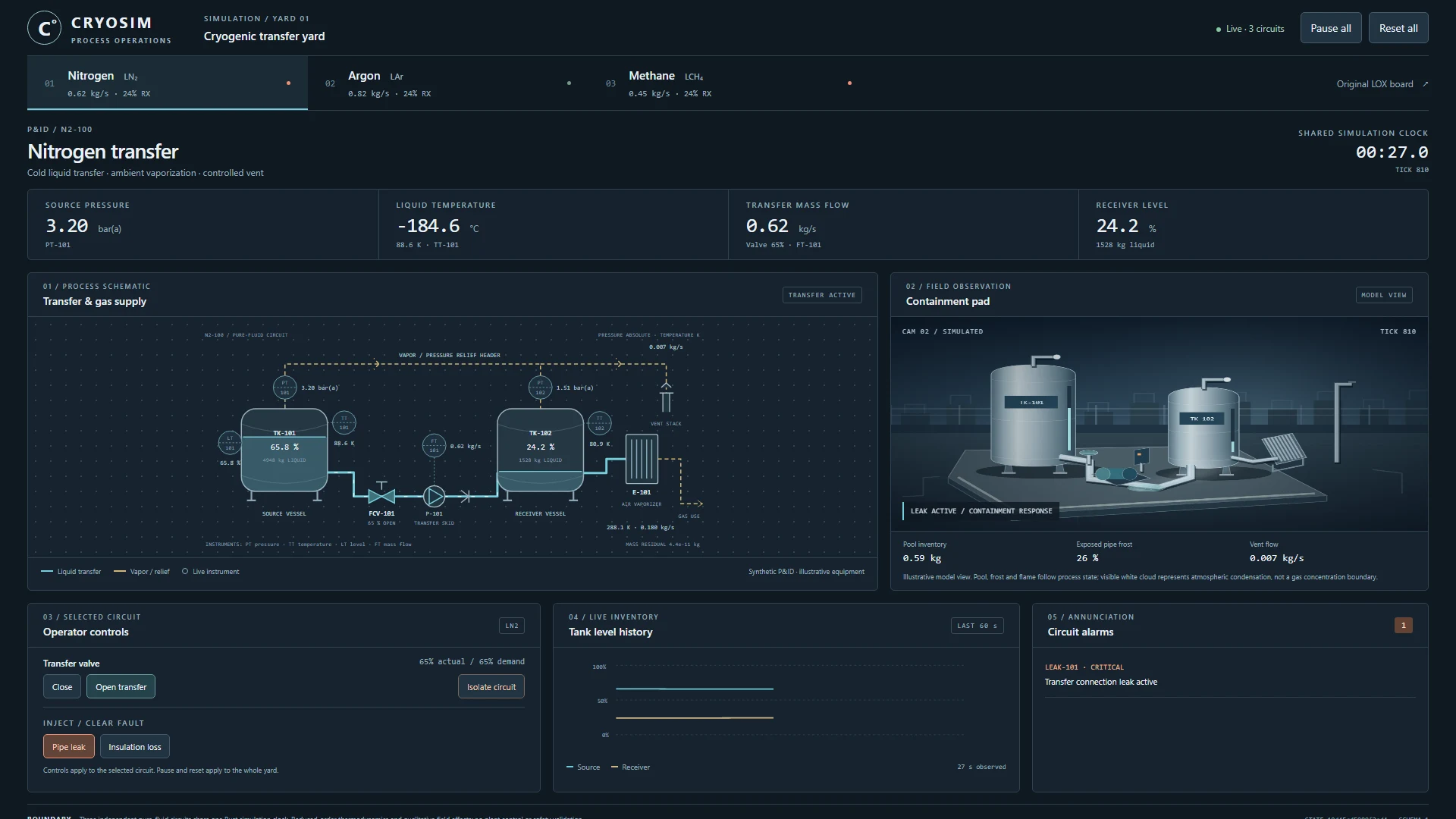
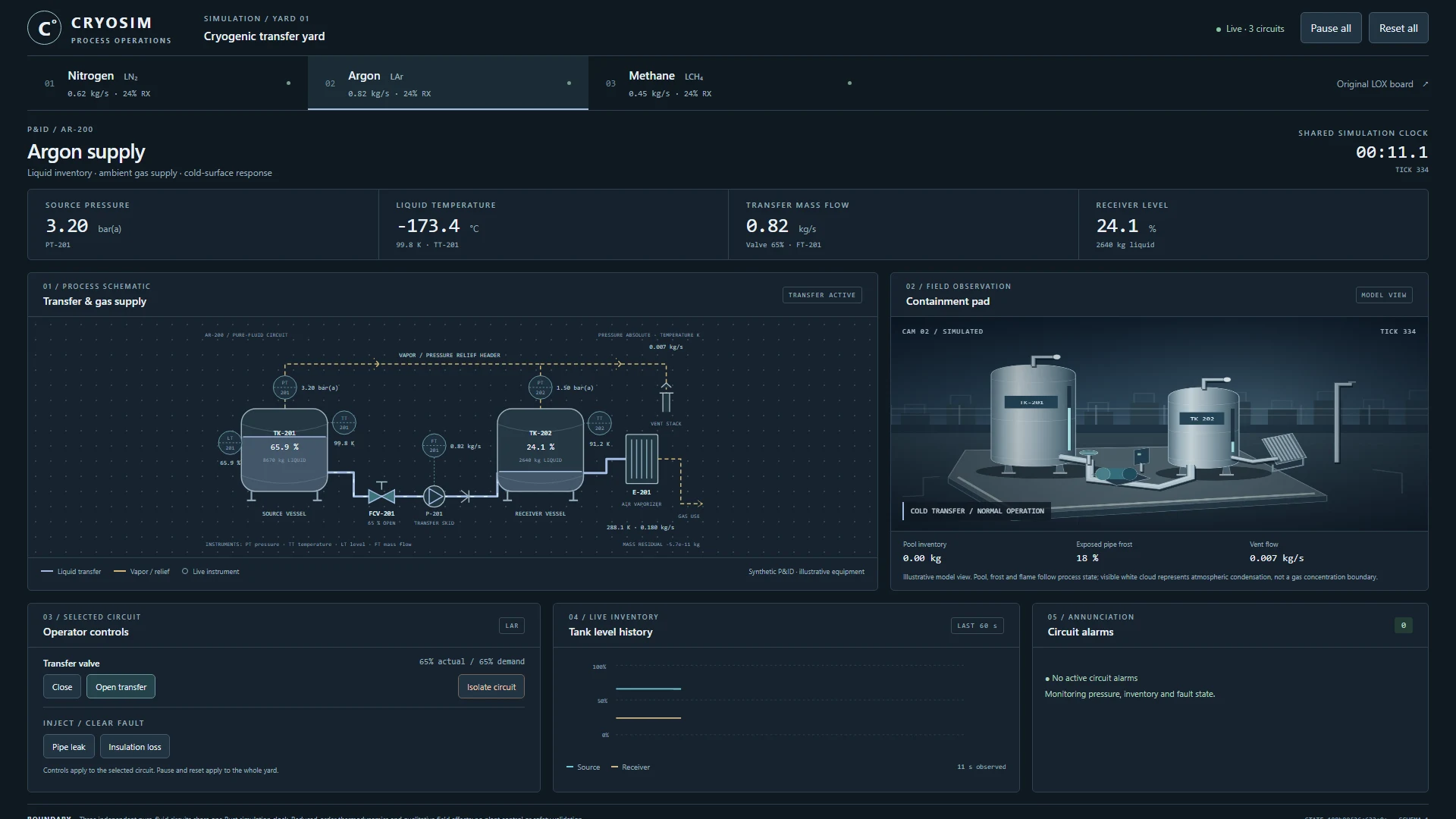
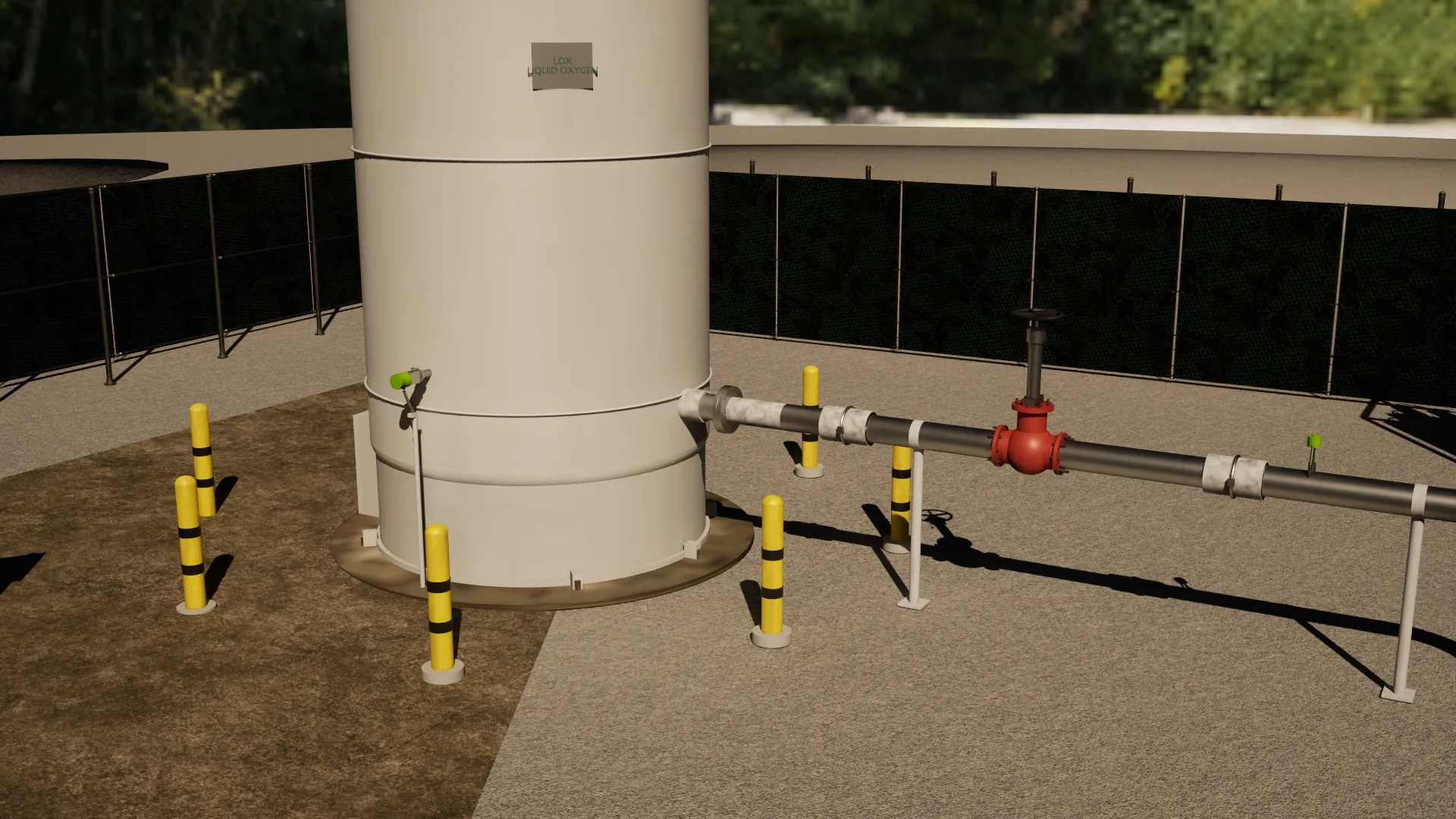
Reflection
The new circuits run together while the operator changes pages. A nitrogen leak feeds a boiling pool; isolation closes the valve while residual liquid keeps evaporating. Methane pilot loss extinguishes the flare and raises an alarm. Live P&ID footage and an explicitly labeled native replay show those behaviors alongside the project's retained scale and camera evidence.
- A dramatic effect needs a physical cause: nitrogen and argon do not burn, a boiling spill can leave liquid after isolation, and frost belongs on cold exposed surfaces or failed insulation. The UI and native scene consume process state; their appearance does not validate consequence physics.
- Deterministic seeds make simulation artifacts auditable in a way that live hardware captures cannot be.
- Separating domain logic into a no-I/O core crate forces the physics model to be fully unit-testable before any service or UI code depends on it.
- Threshold-based artifact validation is more trustworthy than visual inspection alone, but the thresholds need calibration against known-good runs.
- An instrument can pass a black frame: the first packaged Unreal scene rendered black because a rotator's positional order is (roll, pitch, yaw), and a file-existence check and an orphan count by the wrong process name both graded it a pass. Both instruments were corrected before any verdict, and a still now carries its measured luminance.
- A measurement can name the wrong column: a memory gate summed working sets and read a 14-process browser at 1.03 GiB for the page a 7-process browser rendered at 0.63 GiB; the gate moved to private resident bytes with every earlier reading retained and the budget unmoved.
- The instrument's browser is not the owner's browser: ten automated runs of the streamed camera passed while the owner's own browser showed no video, because a decoded-frame callback never fires for a background tab. First-frame detection now uses three signals, and a visual is verified in the owner's client before acceptance.